
This article examines how the US–Iran conflict could fuel food inflation in the Philippines through a weaker peso and persistently high oil prices. Rising energy costs may increase expenses for fuel, fertilizer, transport, and food production, highlighting the need for policies and strategies that strengthen food affordability, supply stability, and long-term resilience nationwide.
by Dr. Bernardo M. Villegas, Co-Founder and Professor, UA&P
Note: This commentary by Dr. Bernardo M. Villegas, a prominent economist, was first published on https://bernardovillegas.org/
I MAY HAVE TO EAT HUMBLE PIE IF THE PHILIPPINE PESO WEAKENS to PHP 60 to a US dollar or above for a long period this year 2026. I have been convinced that “the Philippine peso will not be a ‘senior citizen’ any time this year.” I had predicted that the exchange rate will continue to stay at the PHP 59 to US$1 for the whole of this year, reasoning that the Bangko Sentral ng Pilipinas (BSP) has more than enough dollar reserves to protect the local currency from depreciating beyond what is considered a psychological barrier of PHP 60 to US$1. It is obvious that the barrier has been breached. The whole thing now hangs on how soon can President Trump de-escalate the Middle-Eastern war. If the war continues for more than a month more, we can expect the peso to trade within the PHP 60 to PHP 60.50 levels in the near term. Should there be a de-escalation of the war, the peso can quickly get back to below PHP 60 level, as it has been doing in the last few days.
Those who take a more pessimistic view of a continuing high price of oil above the US$100 a barrel level point out that even if the war ceases soon and the Strait of Hormuz is once again open to traffic of all vessels, the destruction of petroleum-producing facilities has been so massive that it will take some time before the supply of oil to the world will return to normal. Even if the price of oil goes down below the US$100 level, it can be expected to be in the high eighties or nineties for the whole of 2026.
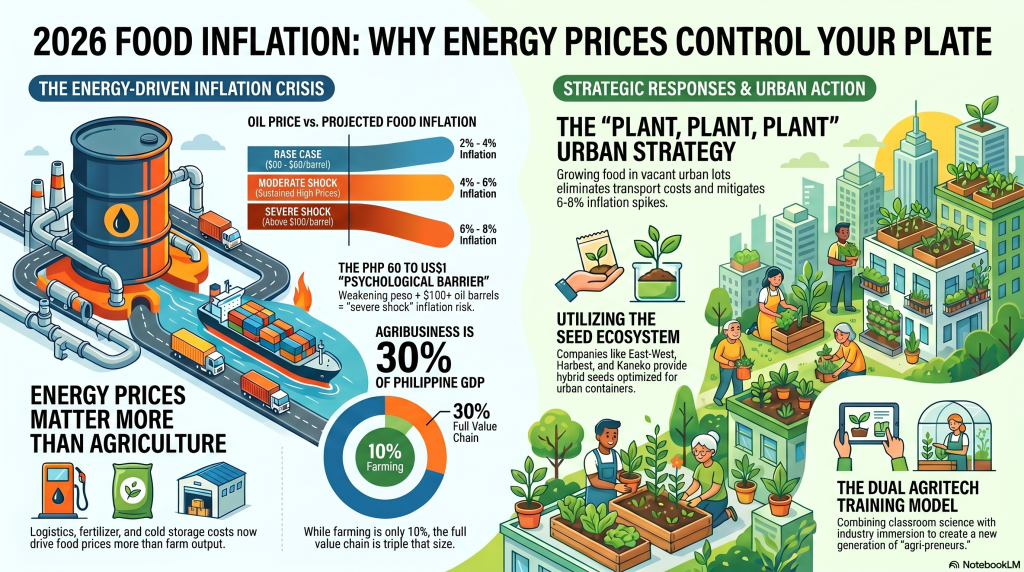
Note: This infographic is generated by Notebook LM
Do you want to read the full article? Please answer this form, and we will send the article to your email address.