Philippine Agriculture Amidst Global Disruptions: Assessing Performance, Risks, and Opportunities

This article examines the implications of recent global developments for Philippine agriculture, reviews the sector’s performance in 2025, presents the outlook for 2026, and identifies key risks and opportunities. It highlights the need for resilience, innovation, and strategic action to strengthen food security, competitiveness, and sustainable growth in a changing global environment for stakeholders nationwide.

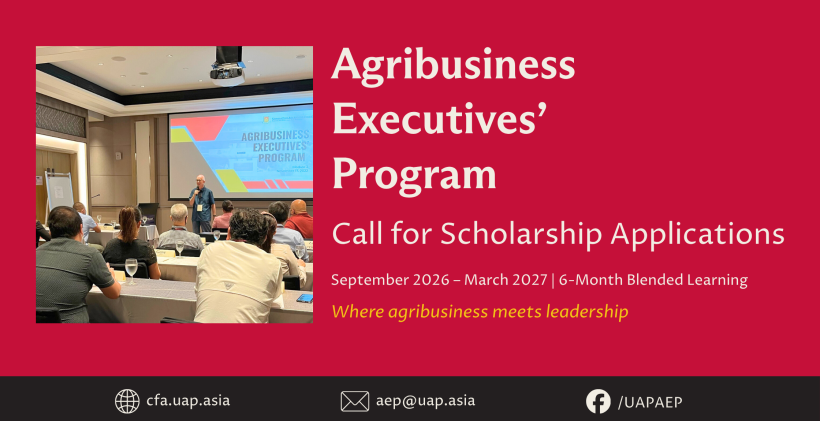
Scholarship Applications Still Open for the Agribusiness Executives’ Program (AEP) – Batch 2026

We are pleased to announce that scholarship applications are still open for AEP – Batch 2026 AEP is a 6-month certificate program for agribusiness executives and managers, featuring six modules, expert faculty, and practical learning through case studies, simulations, and peer collaboration. Note: Modules 1- 2 are half-day online classes, while Modules 3-6 are full-day

Philippine Agricultural Exports: The Big Picture

This article examines the state of Philippine agricultural exports, assessing the country’s performance relative to ASEAN and global markets. It highlights key trends, challenges, and emerging opportunities while underscoring the importance of exports in strengthening competitiveness, expanding market opportunities, supporting sustainable agricultural growth, and enhancing the sector’s resilience, productivity, and overall economic contribution through innovation.

Private Sector Response to Food Inflation

This article examines how the US–Iran conflict could fuel food inflation in the Philippines through a weaker peso and persistently high oil prices. Rising energy costs may increase expenses for fuel, fertilizer, transport, and food production, highlighting the need for policies and strategies that strengthen food affordability, supply stability, and long-term resilience nationwide. by Dr.

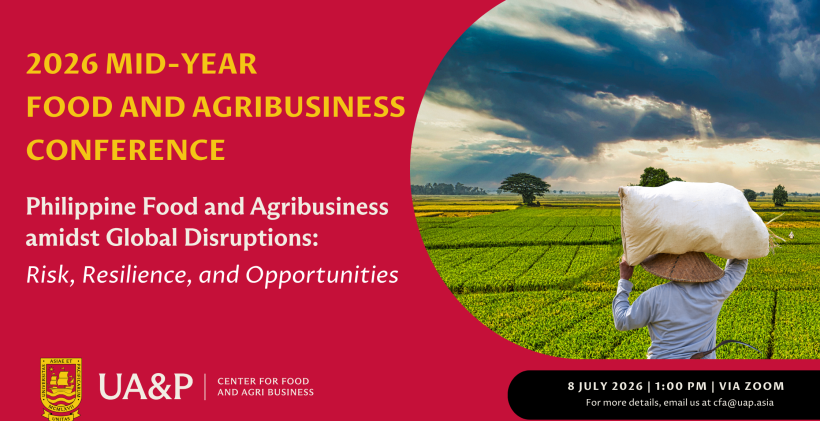
2026 Mid-Year Food and Agribusiness E-Conference

SAVE THE DATE! Join us for the Mid-Year Food and Agribusiness E-Conference 2026 as industry leaders, experts, and stakeholders come together to discuss: “Philippine Food and Agribusiness amidst Global Disruptions: Risks, Resilience, and Opportunities” July 8, 2026 1:00 PM – 5:00 PM Via Zoom Discover insights on navigating global challenges, strengthening resilience, and unlocking new

CFA Briefer Global shock, local strain: Philippine agriculture and the US–Iran war

Global shock, local strain: Philippine agriculture and the US – Iran war

This article highlights how rising tensions between the United States and Iran are affecting Philippine agriculture. Despite the distance, disruptions in global energy flows are raising farm costs, tightening supply chains, and increasing food prices, underscoring the country’s reliance on imported fuel, fertilizer, and feed inputs, and exposing vulnerabilities in long-term food system resilience today.

Rethinking Agriculture’s Role in the Philippine Economy

This article reframes Philippine agriculture as a dynamic agribusiness system that extends far beyond the farm, linking inputs, processing, logistics, finance, and markets across the broader national economy today. It argues that recognizing and strengthening these interconnections is essential to reposition agriculture as a core economic pillar and a sustained driver of inclusive national growth.

Balancing Balancing People, Planet, and Profit in Philippine Agriculture: Examples from the Field

This article positions sustainable investment in Philippine agriculture as a critical response to food insecurity and resource pressure. Centering on the Triple Bottom Line, it highlights how organizations can prioritize social equity and environmental protection while remaining economically viable. Through case studies, the article demonstrates sustainable growth that replaces mere output maximization with responsible value.

Agriculture Scenarios 2025-2026

The article examines Philippine agriculture as a cornerstone of the economy, shaping livelihoods, employment, trade, and rural development. It presents 2025 performance, growth drivers and dampeners, and 2026 outlook. Crops dominate output, followed by livestock, poultry, and fisheries, highlighting the sector’s broad composition and economic contribution across major subsectors including aquaculture and forestry support services.