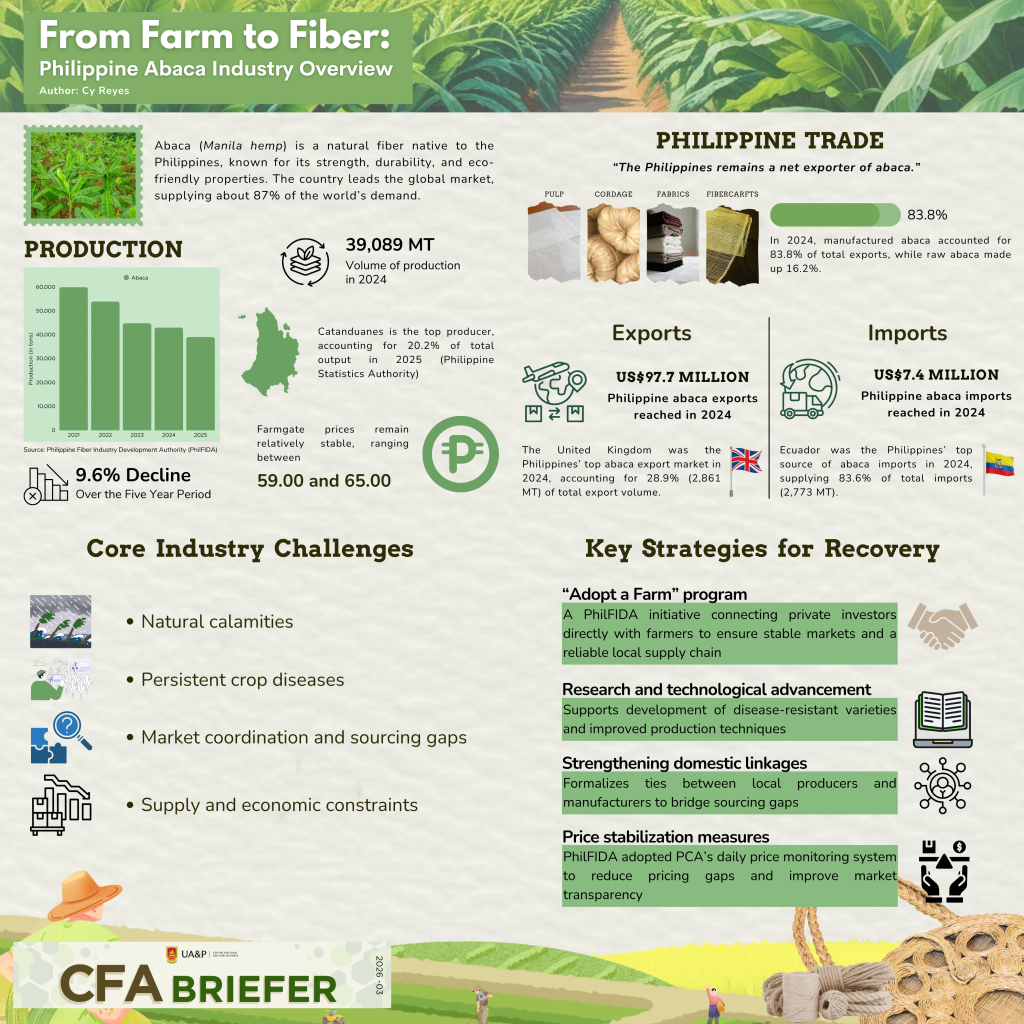
This article highlights the Philippine abaca industry, a major source of globally traded natural fiber. Known for its strength and versatility, abaca is used in products from ropes to currency paper. Supplying about 87% of global demand, the Philippines remains the leading producer and exporter, reinforcing its strategic role in global fiber markets and industries.
by Cy P. Reyes, Research Assistant, Center for Food and Agri Business, UA&P
ABACA (MUSA TEXTILIS), also known as Manila hemp, is a natural leaf fiber species of banana grown as a commercial crop native to the country. Its leaf stems are harvested for their natural fiber that possesses valuable properties such as buoyancy, high porosity, high tensile and folding strength, and resistance to saltwater damage, making it suitable for various products such as apparel, ropes, and furniture (Philippine Council for Agriculture, Aquatic, and Natural Resources Research and Development [PCAARRD], 2023). Apart from making apparel, ropes, and furniture, abaca is also used for tea bags, sausage casing, surgical masks, and cigarette paper. The Bangko Sentral ng Pilipinas also uses abaca to make paper bills.
The Philippine abaca industry plays a crucial role in both the global economy and environmental sustainability. The Philippines is the world’s largest exporter of abaca, supplying approximately 87% of global demand, according to the Philippine Fiber Industry Development Authority (PhilFIDA) under the Department of Agriculture. Abaca is considered an environmentally sustainable fiber due to its biodegradability, renewability, and low reliance on chemical inputs.
Do you want to read the full article? Please answer this form and we will send the article to your email address.