
This article reframes Philippine agriculture as a dynamic agribusiness system that extends far beyond the farm, linking inputs, processing, logistics, finance, and markets across the broader national economy today. It argues that recognizing and strengthening these interconnections is essential to reposition agriculture as a core economic pillar and a sustained driver of inclusive national growth.
by Marie Annette G. Dacul, Executive Director, Center for Food and Agri Business, UA&P
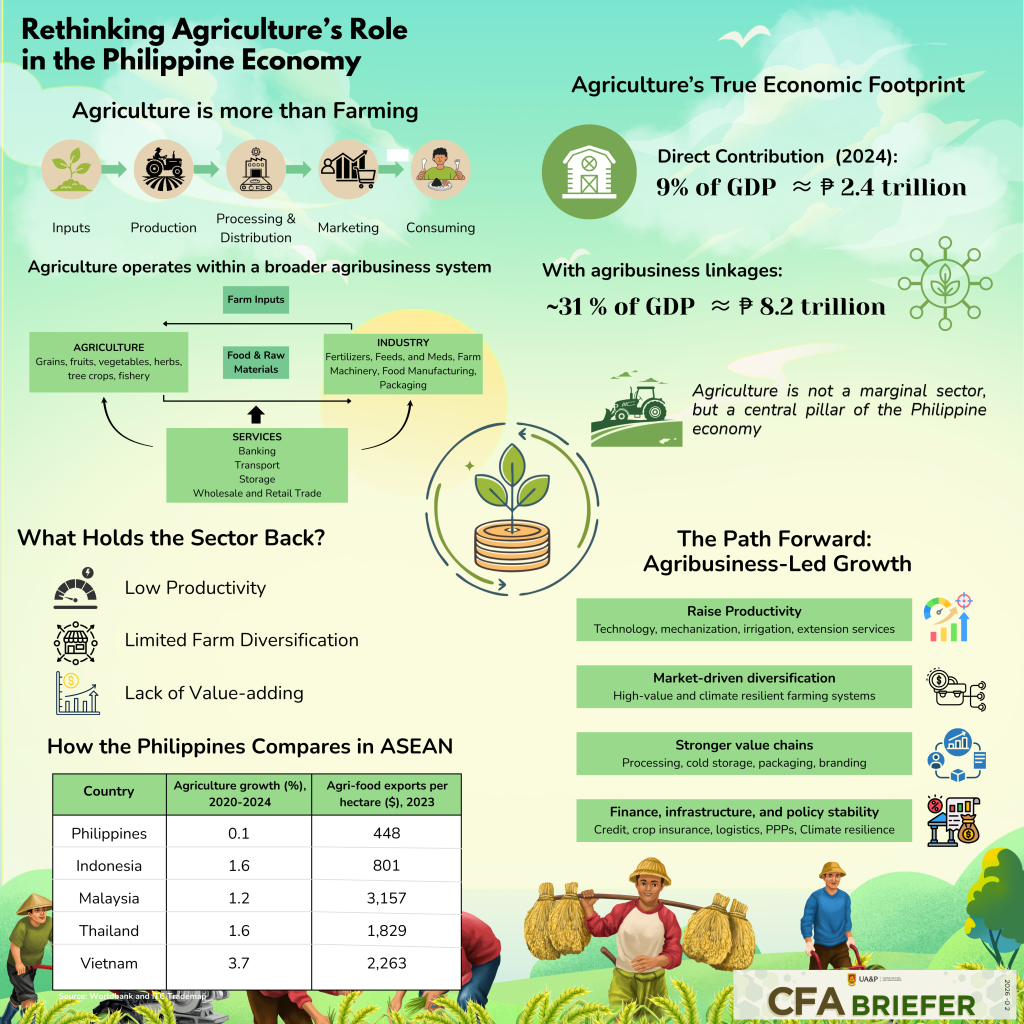
AGRICULTURE IS OFTEN UNDERSTOOD AS AN ACTIVITY CONFINED TO THE FARM – planting, cultivating, and harvesting crops, raising livestock and poultry, or producing fish. This narrow perspective understates the sector’s true economic reach. In practice, agriculture operates within a broad agribusiness system that links producers to suppliers of inputs, processors, logistics providers, financiers, traders, and ultimately, consumers.
Viewed through this wider lens, agriculture’s role in the economy changes fundamentally. It is no longer a stand-alone or declining sector, but a core pillar that supports both industry and services. Because the value chain is highly interconnected, disruption or inefficiency in any segment has implications across the entire system.
For the Philippines, recognizing and deliberately strengthening these linkages is critical to transforming agriculture into a sustained driver of growth.
AGRICULTURE’S TRUE ECONOMIC FOOTPRINT
Measured directly, agriculture accounts for only about nine percent of Philippine gross domestic product (GDP), equivalent to roughly PhP2.4 trillion (T) at current prices in 2024. This figure, however, captures only primary production – crops, livestock, poultry, and fisheries, and excludes the wide range of economic activities that depend on agricultural output.
Once processing, manufacturing, logistics, wholesale and retail trade, transport, storage, finance, and related services are included, agriculture’s footprint expands substantially. Food manufacturing alone contributes a comparable share of GDP to primary agriculture, while services linked to agricultural production and distribution add even more value.
Do you want to read the full article? Please answer this form and we will send the article to your email address.